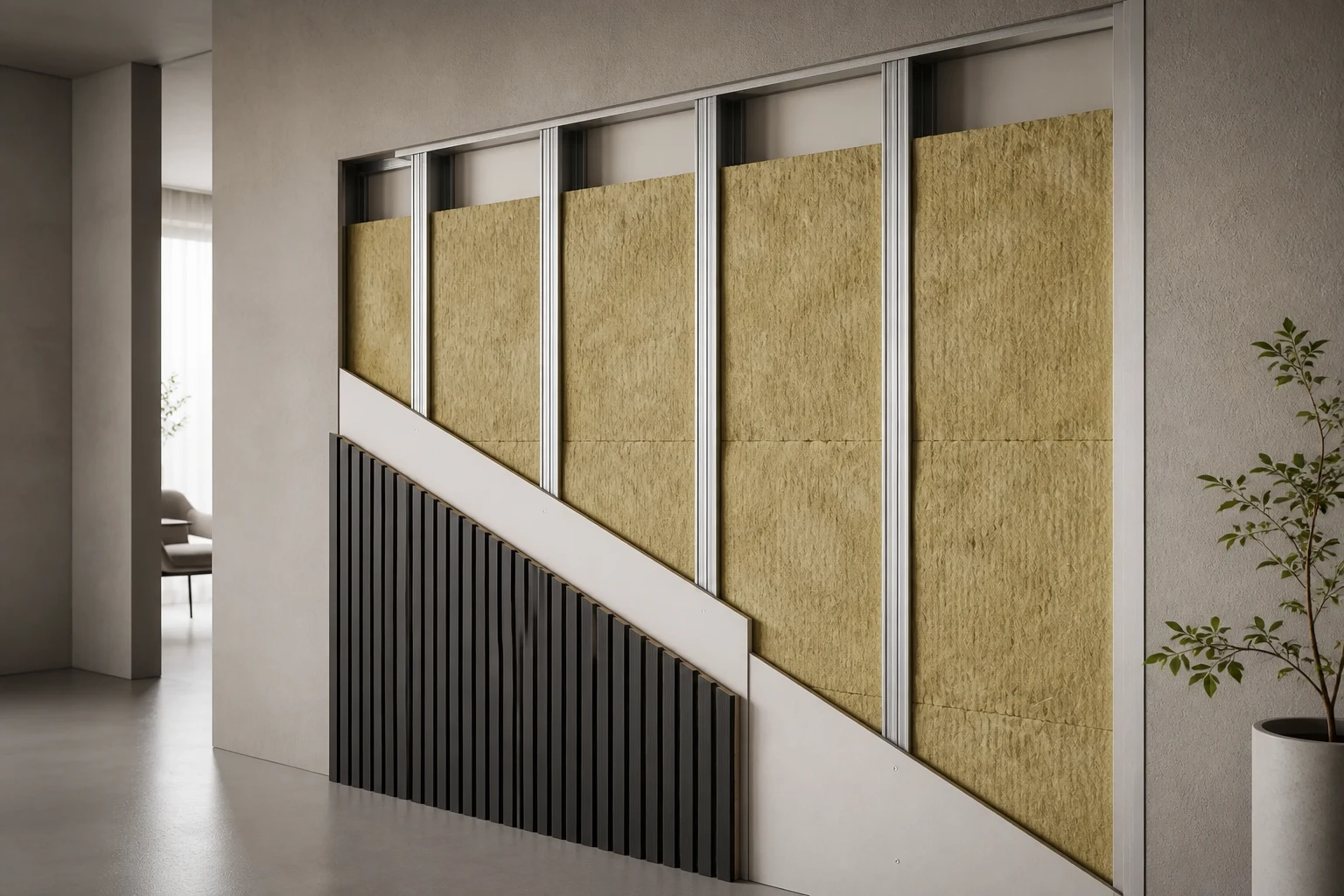
Partition wall acoustic insulation depends on the complete assembly: framing, linings, cavity infill and junctions. Suitable mineral wool helps absorb sound within the wall, but cannot replace airtight installation or a tested system specification.
Partition wall acoustic insulation — what determines performance?
At a given wall thickness, sound insulation depends on the cavity infill, airtight installation without acoustic bridges, and the wall structure itself. For example, separate frames can reduce sound transmission compared with a single shared frame, depending on the complete system.
Selecting mineral wool for acoustic performance
Mineral wool absorbs sound through its fibrous structure, which dissipates acoustic energy. Density is one factor, but a higher density alone does not guarantee better sound insulation. For partitions with demanding acoustic requirements, select the infill as part of a tested or assessed wall system, considering thickness, airflow resistance, linings and structural connections.
Common installation mistakes
Even a well-selected material cannot compensate for air gaps or rigid connections that transmit sound between the linings and the building structure. Fully filling the spaces between studs and carefully sealing the perimeter and board joints are essential to good acoustic performance.
Explore products and installation guidance for lightweight partition walls. View application
For a general overview of mineral wool insulation, see the EURIMA guide. Confirm the properties of the selected Eurowool product in its technical datasheet and Declaration of Performance.